Trademark scams are on the rise, leading to confusion amongst trademark owners. In fact, in August 2025, the United States Patent and Trademark Office (USPTO) took the extraordinary step of sanctioning a foreign filing firm and terminating over 52,000 trademark applications and registrations connected to a large-scale fraud scheme. The firm had submitted documents on behalf of trademark owners without authorization, impersonated U.S.-licensed attorneys, forged electronic signatures, and submitted fake evidence of trademark use.
What about the owners of these applications and registrations? The sad reality is most all of these applicants were small businesses or other innocent applicants looking for lower-cost trademark services. The USPTO refunded none of their filing fees, and the scammers ran off with the money they had been paid. The USPTO retained their fees and got paid, but applicants and registrants lost tens of thousands of dollars in cases we have personally seen.
The good news? Most trademark scams share recognizable warning signs. If you can learn how to spot the scams and what to do if you receive suspicious communication, you should be able to protect your trademark and yourself.
Common Trademark Scams
Trademark scams can take various forms, however there are two very popular options for scammers: (1) imitating the USPTO, or (2) imitating a licensed attorney or paralegal.
Scams imitating the USPTO often claim false renewal periods for your registered trademark or fake office actions from the USPTO with respect to your registered trademark.
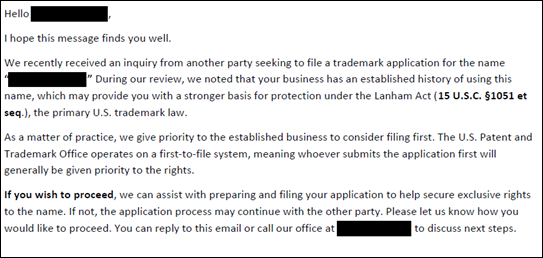
Imitations of licensed attorneys also often include false claims that your registered mark is up for renewal. Another common approach is a claim that the “attorney” has a client is filing a competing mark and offering to intervene or offers to negotiate licenses for your already registered marks. A variation of that scam occurs when you previously filed for a trademark and the mark either did not get approved or was inadvertently abandoned and the “attorney” offers to help you protect your lapsed rights ahead of their client by filing a trademark application for you. Recently we saw an example where the client had never made a trademark filing but had a long-established business which proves how creative the scammers can be in finding potential targets. In that case, what the scammer did not mention when offering to file a mark for our client was that there was already an identical registered mark at the USPTO which would have precluded the filing of an application for both our client and for the scammer’s fictitious client.
An example of a common trademark scam email can be seen below.
Red Flags: How to Identify a Scam
Recognizing a scam quickly is the first line of defense for trademark owners. These scams don’t have any preferred communication method—they may arrive by mail, by fax, by email or even through spoofed phone calls. Be wary of any communication that includes extreme urgency. Scams will often demand you respond or pay within hours, threatening permanent consequences if you don’t act immediately. Also, know that attorney ethics rules require attorneys to exercise loyalty to their clients. Any attorney that would offer to register your mark ahead of their client’s mark is not an ethical attorney.
Unusual payment methods are another hallmark of trademark scams, requesting payment via PayPal, Venmo, Zelle, wire transfer, or other unofficial method of payment. The USPTO only accepts payment through its official online systems or, in rare cases, by check or money order made payable to the “Director of the USPTO.” Any emails claiming to be from the USPTO should end in “.gov” and not “.com” or any other domain but, other than in a very limited set of circumstances, you most likely will never get an email from the USPTO. Finally, be especially cautious of any communication you weren’t expecting, particularly if it asks for money or sensitive information.
What to Do If You Suspect a Scam
If you suspect that you have received a scam email, phone call, or other message regarding your trademark, there are multiple steps you can take to protect yourself and your mark.
- Do not send payment. If you pay a scammer, the money is likely gone for good.
-
Verify the claims. Any insufficient payments or deadlines can be verified using the USPTO’s
Trademark Status and Document Retrieval (TSDR) database by searching your registration or application number. Additionally, you can reach out to a U.S. attorney to verify the legitimacy of the claims and identity of the potential scammer. Ideally that attorney will be someone whom you have worked with in the past, but at a minimum it should be an attorney who has no relation to the party who has reached out to you and preferably someone who has a trademark specialty. Use contact information you already have or that you independently identify, not any contact details provided in the suspicious message, and they will help you sort through the potential scam. You may also reach out to the USPTO’s Trademark Assistance Center at 1-800-786-9199 to confirm any claims or ask questions about your registration. Finally, consider reporting fraudulent communications to the USPTO and your state Attorney General to protect other trademark owners.
- Retain a US attorney to maintain and monitor your application. While this is not necessary to spot or rebuff scams, it can help to alleviate the burden of fraudulent claims and communications and the confusion that can come from those. Trademark attorneys are very familiar with these scams at this point, and provide security that there are no outstanding fees or deadlines from the USPTO.
Protect Yourself Going Forward
The best defense against trademark scams is vigilance. Approach all unsolicited communications about your trademark with healthy skepticism — especially those that pressure you to act quickly or request immediate payment.
Keep your own records of your trademark registration dates, renewal deadlines, and any attorneys or firms you've authorized to act on your behalf. When in doubt, verify before you act.
If you've received a suspicious communication about your trademark—or if you're simply unsure whether a notice is legitimate—consult a qualified trademark attorney that is familiar with official communications from the USPTO for guidance.
These scams can be a headache and a major annoyance. While everyone believes that they will not fall prey to a scam, scammers increasingly adopt more deceptive practices to target more sophisticated applicants as well.
The Between the Lines blog is made available by Mitchell, Williams, Selig, Gates & Woodyard, P.L.L.C. and the law firm publisher. The blog site is for educational purposes only, as well as to give general information and a general understanding of the law. This blog is not intended to provide specific legal advice. Use of this blog site does not create an attorney client relationship between you and Mitchell Williams or the blog site publisher. The Between the Lines blog site should not be used as a substitute for legal advice from a licensed professional attorney in your state.